You know what’s cool? Raising a couple hundo-mil round. You know what’s insane? Raising a single round the size of the GDP of a small island nation.
Yesterday, new-age manufacturing company Re:Build announced that it’s raised $2.1B in funding led by General Catalyst and JPMorganChase’s Strategic Investment Group to “expand [its] capacity to manufacture hard tech products and launch new industrial startups.”
- The round brings total funding to $4B. Sheesh.
- Worth noting: Aerospace and defense accounts for about 40 percent of the company’s business. So yes, you should care.
Re:Build CEO Miles Arnone told Tectonic that the cash money will enable the company to scale up production capacity, spin out more product-based startups (more on that later), and buy up more companies (they’ve already snapped up about 13).
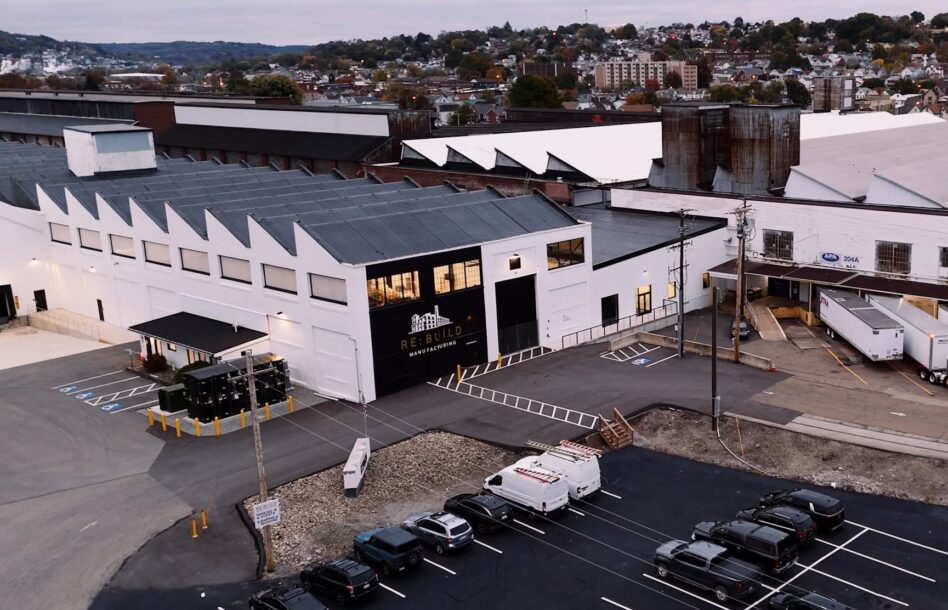
“We’ve built the company now…to about 2000 people and several million square feet of manufacturing space,” he said. “This will allow us to really accelerate from here, so we can take the foundation we built and go to another order of magnitude in scale.”
“We’re trying to solve a very large problem and an expensive one to solve,” he added. “We’re trying to undo 40 years of deindustrialization.”
Built better: Now, Re:Build is a pretty heavy hitter in the whole reindustrialize space.
- The company was founded back in 2020 and essentially helps other businesses design, develop, and manufacture physical products better—from aerospace and defense components to medical devices and industrial equipment. (Pretty productive pandemic, we’d say.)
- The idea is to bring product design, engineering, and production together and optimize each from the get-go, making it easier (and cheaper) to take products from concept to mass production. They also use all that fun automation and advanced manufacturing stuff we know and love.
- A big part of the company’s approach is something called Manufacturing Constrained Design (MCD)—essentially, a way of designing products around how they’ll actually be manufactured, rather than figuring out how to mass-produce them after the fact.
- Acquisitions have also been pretty key to building out its capabilities. Re:Build buys specialized manufacturing businesses (like, say, composite manufacturers or a really cool molding company) to expand the range of products and components it can make.
Pick your poison: Per Arnone, they’ve got two different approaches when building for customers. (Each accounts for about 50 percent of the company’s business, but he far prefers the latter.)
- The company can take an existing production line at, say, a big ol’ prime and modernize it a little bit, or build components for existing production lines. “We look at those systems. We find the bottlenecks. We look at where automation can be appropriately applied,” he explained. “We work with the conventional supply chain, and we also provide them with a lot of subsystems and components. We produce a lot of parts for them.”
- Or, they can help companies redesign things to optimize production and economics from the get-go. Arnone says this approach is popular with “neoprimes” and newer companies entering the space that are building more attritable systems. “We work with those companies earlier and often help them design those products from the ground up,” he said.
“We design a lot of UAS and counter UAS and other vehicles of that nature, all the way down …to every component, whether it’s thermoset composites, metallics, thermoplastics, the wire harnesses, the sensor pack, all of that,” he added. “We will help them design, prototype, and ultimately put up lines to build those products.”
When helping drone companies design from the ground up, he said they’ve been able to essentially get to China levels of cheap (while keeping them Blue UAS compliant).
“We’ve done some work…around Group One drones,” he said. “We’ve been able to get to a point where we can produce them in the U.S. now at pretty close to DJI prices, which is a pretty radical development.”
Spinning out: And the company isn’t just building for other people—they’ve also spun out a few different product-focused startups, including:
- Slate Auto: An EV startup developing low-cost, customizable electric pickup trucks designed for mass production in the US.
- Neon Aero: An aerospace manufacturer producing propellers, rotors, and flight-control systems for aircraft ranging from small drones to larger turboprops.
- Ensorcell: A life-sciences company developing affordable laboratory and bioprocessing equipment, including imaging systems, gas mixers, and tube welders.
When we asked why they spin out (rather than, say, building these products in-house), Arnone said it was (basically) because building standalone products isn’t the company’s main thing.
“Rebuild’s a service business,” he explained. “We provide engineering production services. If we come up with something that is a product that we think would benefit the market, then we will tend to create a separate company for that, make sure it has strong management on its own, build it out, and off it will go.”
Big ups: Arnone said that this enormous pile of cash will basically enable Re:Build to do everything that they’ve been doing—acquiring smaller manufacturers with unique production processes, spinning out startups, and building out their own production capacity—but at a much larger scale.
“Within the next five years, we will probably triple in size…our organic growth rate plus modest acquisitions easily supports that,” he said. “We’ll be serving a larger number of customers and have a broader portfolio of engineering and production capabilities. [We’ll add about] another million plus square feet of production space, and another 1000 plus employees.”