Well, it seems the era of all that hand-wringing over whether Europe would be able to ramp up defense tech funding might be coming to a close.
This morning, UK-and-Berlin-based AI-for-defense startup Agon announced that it’s raised a $70M Series A at a $450M valuation, led by Northzone, alongside other existing investors, including Lakestar, XYZ, Lux Capital, and Global Founders Capital.
- The UK Sovereign AI Fund and the National Security Strategic Investment Fund (NSSIF) also jumped in the round.
- Former Sequoia head Roelof Botha has also joined as investor.
- The raise comes less than five months after Agon emerged from stealth with $30M in funding. Money moves, indeed.
The plan, Agon founder and CEO Tristam Constant told Tectonic, is to use this new funding to build out their platform from a “synthetic battle lab” into an “AI lab for European defense.”
“We set out to build what we describe as the foundational infrastructure for agentic warfare—effectively a gym for training defense AI,” he said. “That’s what we’ve been busy building over the past several months…[but] it’s become increasingly clear that more needs to be done to actually invest in the development of foundation models themselves…for European defense.”
“We have built the gym. Now, we’re going to start training athletes,” he said.
Star player: Agon is a very, very new kid on the block—the company was founded earlier this year by Constant (formerly of Applied Intuition, Anduril, and the British Army) and Junaid Hussain (co-founder of Cambridge Aerospace and Iconic, among other companies).
- The startup is also chaired by David Helgason, founder of the gaming engine company Unity. Helpful when you’re doing the whole synthetic worlds thing.
- They’ve also brought on alumni from Anduril, Applied Intuition, Google, Helsing, Palantir, Amazon, and Havok.
The initial goal was to build a virtual training ground for autonomous systems—a synthetic battle arena where models could duke it out against virtual adversaries (powered by real-world data) to improve how they perform and fight.
- When we talked to him this summer, Constant described that initial effort as a “horizontal infrastructure layer that drone manufacturers can build upon for looking to build and train autonomy for all domains and for defense institutions and the military.”
- The idea is that before you spend thousands of hours (and millions and millions of dollars) testing endlessly in the real world, you can hone your models in a digital one. As we said when they launched, it’s a lot less painful to lose an expensive asset in the digital world than it is in the real one.
“Real-world experimentation, when it comes to training autonomy, is too expensive, too slow, too difficult to scale up,” Hussain told Tectonic. “You cannot run billions or trillions of different experiments in the real world. You cannot cover edge cases that are difficult or dangerous to replicate.”
Build it out: But as they built and scaled that virtual battleground over the past few months, the Agon team realized that, well, they could go a heck of a lot further.
“We [saw] the opportunity to train foundation models to help accelerate the development of autonomous systems across the industry,” Constant said. “That’s an incredibly underinvested part of the landscape.”
- Essentially, they realized that the training environment—defense gym—they’d built gave them the perfect setup to build models themselves. Hussain said they realized it was “existentially important [that they] are now pushing on beyond just building and providing the infrastructure.”
Wellness center: From here, the aim is to grow into (basically) a one-stop-shop for all things AI-for-defense—the (virtual) place where the best models are built and trained, and where Europe’s smartest autonomous systems make sure they’re, well, ready for the battlefield.
- While Hussain and Constant wouldn’t tell us exactly where their training data will be coming from, they said it’s a potent combo of inputs from defense, customers, and open-source stuff available right here on the Internet.
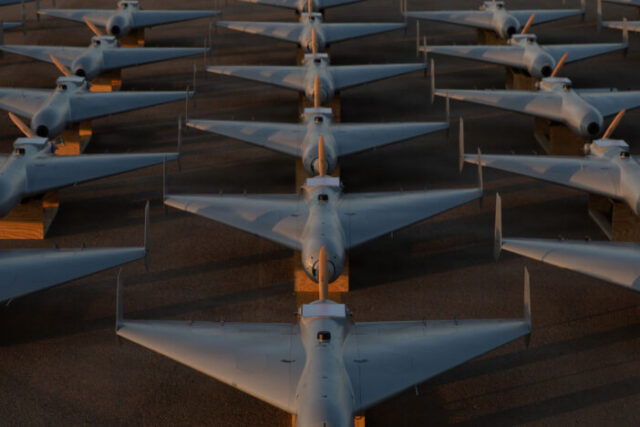
- They use a heck-ton of that data to keep things as close to real-time, real-world, and up-to-date as possible in the training environment. But because, well, it’s all virtual, they can also test against potential future threats—like, say, a Geran that can travel 1000 km/hr.
“By virtue of building the synthetic battleground…we can run these [future-looking] experiments. We do every single day,” Hussain said. “What would happen to this existing capability if this future threat were to arise? Or, now that this future threat has been cited on the battlefield, what does it mean for existing systems? Or, if we were to develop this future system, where might it fail?”
Cash money: But here’s the thing: Building an AI lab is not a cheap undertaking. Hence the lightning-quick Series A.
- Most of the funding, Constant and Hussain said, will go towards building out a world-class team of AI researchers who want to build for security and defense. It’ll also fund a whole heck of a lot of compute—all the R&D investment necessary to seed a lab, Constant said.
“We are in an AI arms race. Europe is in an AI arms race, whether it chooses to recognize it fully or not,” Constant said. “There is no time to slow down and take a slow, methodical approach to this. We need to move quickly. We need to act quickly. Clearly, we need to build the business in a way that is deliberate, and we are doing so.”
“[But] this is about initiating our next phase of growth and expansion…[and] time is of the essence,” he added. “Our strategic adversaries are already making investments in this space, and there is an absolute absence of what’s required currently [in Europe].”