The Pentagon’s Office of Strategic Capital has been on a dealmaking tear this year, but all those billions in loans to defense and defense-adjacent companies could soon look pretty quaint if it moves forward with a massive—and we mean massive—loan to Hadrian.
Late yesterday, investigative journalism nonprofit ProPublica reported that the OSC is in preliminary talks to award the $8B advanced manufacturing startup an eye-popping $15B loan to dramatically scale up its operations at a dozen new automated factories across the country.
The deal would be ten times the size of the largest conditional loan agreement—$1.5B to semiconductor component company Wolfspeed—that the OSC made under the Trump administration.
But it could present a few, erm, issues.
Under the microscope: On Capitol Hill, Democrats are vowing to scrutinize contracts and loans awarded to defense firms with ties to the Trump family—especially portfolio companies of 1789 Capital, where Donald Trump Jr. is a partner—when they take power in both chambers of Congress next year.
- 1789 Capital has backed Hadrian—among other defense startups—in multiple rounds, including Hadrian’s $1.37B Series D at a nearly $8B valuation in August.
This proposed OSC loan (which a Pentagon spokesperson told ProPublica is in the “early stages”) could be further complicated by an audit into contracts and loans to defense startups launched by the department’s Inspector General on Friday.
- According to the IG’s announcement, the “objective of this audit is to determine whether the DoW’s processes for issuing awards complied with applicable laws and regulations, specifically controls for preventing improper influence and safeguarding nonpublic information.”
- “In selecting sample awards for audit, we will consider achieving coverage across all Services and a DoW agency; including all award types—contracts, other transactions, loans, and equity investments—prioritizing high-dollar awards; and ensuring representation of major industries, such as rare earth minerals, drones, super intelligence, and rocketry,” it added.
The ProPublica report also comes right on the heels of Rep. Jamie Raskin (D-MD), the likely incoming chairman of the House Judiciary Committee, launching his own probe into companies tied to 1789 Capital.
- In a letter published on Tuesday, Raskin requested records of communications with 1789 Capital from Hadrian and other portfolio companies, including Polymarket and vaping company Juul. The goal is to examine the extent to which these companies “benefited, or stand to benefit” from government contracts or regulatory decisions.
- 1789 Capital execs, including Trump Jr., have routinely denied any involvement in, or say over, the government contracts and regulatory decisions sought by the companies it backs.
Big bets: For a bit of background—the OSC was established under the Biden administration to mobilize private capital to develop, commercialize, and scale technologies critical to US national security and reduce dependence on adversarial supply chains.
Congress authorized OSC to provide direct loans, loan guarantees, and technical assistance to companies deemed critical to the defense-industrial base, though typically with a dual-use mandate to avoid overreliance on government contracts.
- The idea behind the OSC is pretty simple—rather than using pricey VC money to build out defense-industrial capacity, the Pentagon is betting it can use cheap government financing to do the trick. Those low-cost loans help companies scale up, which then (hopefully) unlocks private capital and big contracts.
The scale of the loans, and the loans to companies with little commercial applicability (Congress specifically prohibited loans to companies with solely military applications), have dramatically expanded under the second Trump administration. Those include:
- A $450M conditional loan agreement with drone company Neros and an $820M one with its rival Performance Drone Works (PDW).
- A slate of deals with rare earth element companies, including $150M to MP Materials, $500M to Phoenix Tailings, and $620M to rare earth magnet startup Vulcan Elements, which itself is under close scrutiny due to its ties to 1789 Capital and reports that its deal was pushed through by a top Trump advisor.
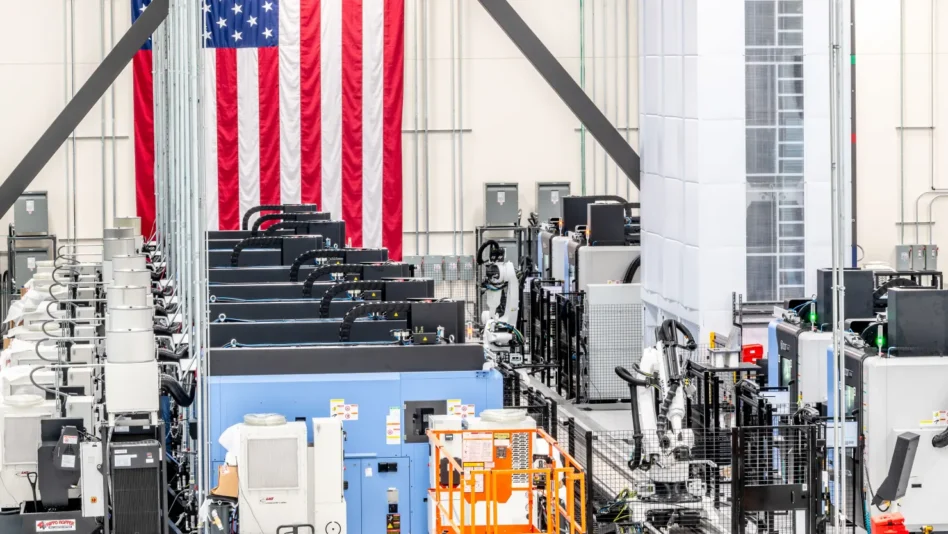
Going dark: The deal with Hadrian is designed to finance the construction of a dozen automated manufacturing facilities focused on ramping up output of munitions, submarine components, and other critical chokepoints in the defense industrial base.
- It also wouldn’t be Hadrian’s first big-dollar deal with the Pentagon. In March, the startup announced a big-time, $2.4B partnership with the US Navy—split between $1.5B in private capital and $900M in government funding—to produce components for the Virginia- and Columbia-class submarines at its 2.2M square-foot facility in Cherokee, AL.
- The company is also working with Lockheed Martin under a seven-year deal to produce parts for interceptors and missiles, including PAC-3 MSE, THAAD, PrSM, and GMLRS.
In a statement, Hadrian disputed ProPublica’s account of the negotiations.
“ProPublica’s story mischaracterizes the status of these preliminary discussions. This was never about one company,” a company spokesperson told Tectonic in a statement. “The proposed loan contemplated the creation of a consortium of manufacturers across the American industrial base including major defense prime contractors, component suppliers, small businesses and commercial manufacturers, to solve America’s critical munitions shortage.”
- Politico Pro later reported that Hadrian initiated the negotiations as the face of a group of companies called the “Arsenal Acceleration Network,” which began pitching the Pentagon in August on the $15B loan to accelerate munitions production.
- An investor pitch viewed by Politico said the loan would go toward solid rocket motor, interceptor, small missile, UAV, and large cruise missile production. It also said the Pentagon’s $15B would be partially matched by $10B in private capital.
Now, the OSC and Hadrian haven’t put pen to paper yet, but the deal would be one of the largest loans the US government has made in its history. Despite the criticality of all the programs Hadrian is working on with the US military—and the multi-company consortium Hadrian is heading up—that’s sure to raise more than a few eyebrows in a Democrat-controlled Congress.
Should be an interesting next few months in these parts, to say the least.
This article has been updated to include comment from Hadrian and new reporting that surfaced after initial publication.